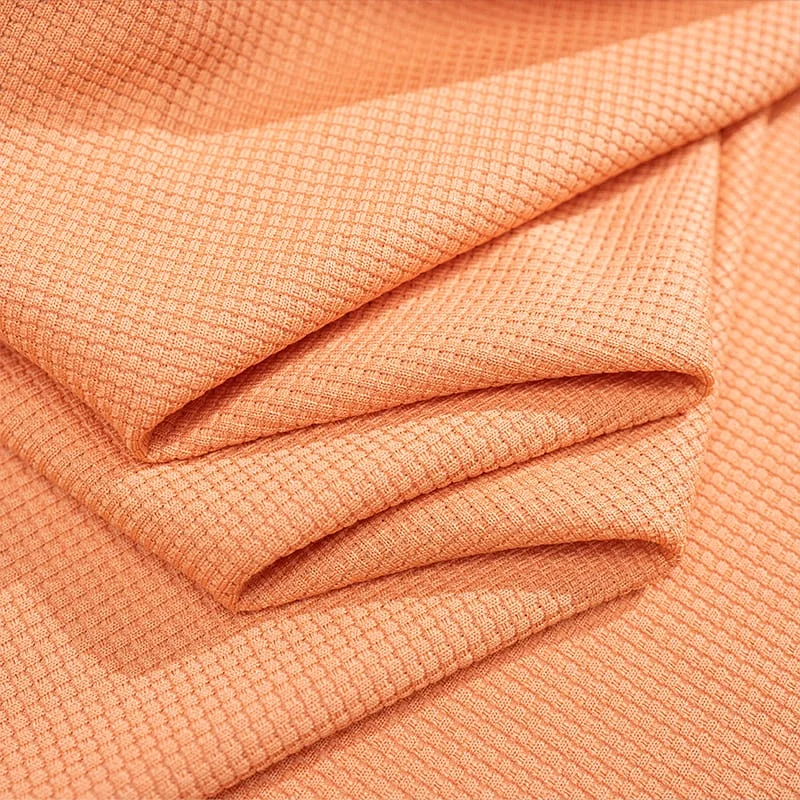
Knit vs Woven Fabric: Sourcing Guide for Manufacturers
For garment manufacturers and sourcing managers, the choice between knit and woven fabric is rarely just an aesthetic preference; it is a fundamental decision that dictates the production line, costing structure, and end-user performance. While the basic distinction lies in how the yarns are constructed, the implications extend to marker efficiency, cutting room protocols, and dimensional stability during the wash cycle.
Selecting the wrong substrate can lead to costly production bottlenecks—such as fabric skewing during spreading or seam slippage in the final garment. Conversely, aligning the fabric structure correctly with the intended application optimizes yield and customer satisfaction. This guide analyzes the technical, operational, and financial differences between knit and woven textiles to support data-driven sourcing strategies.
Structural Mechanics: Loops vs. Interlacing
The defining characteristic of any fabric is its construction method, which determines its physical behavior under stress. Understanding these mechanics is the first step in predicting how a material will handle during manufacturing.
Woven Construction: The Interlace
Woven fabrics are produced on a loom by interlacing two distinct sets of yarns at right angles. The longitudinal yarns (warp) are held under high tension, while the transverse yarns (weft) are inserted over and under the warp. This grid-like structure creates a fabric that is inherently stable and rigid. Unless elastane is added, standard wovens have minimal stretch along the grain, though they possess slight give on the bias (45-degree angle).
Knit Construction: The Interloop
Knitted fabrics are created by interlooping a single yarn (or set of yarns) continuously. In weft knitting (the most common method for apparel like Jersey and French Terry), loops are formed across the width of the fabric.
Because the yarn follows a meandering path rather than a straight line, the fabric structure acts like a series of minute springs. Even without spandex, the loop structure allows for 'mechanical stretch.' When tension is applied, the loops distort and elongate; when tension is released, they attempt to return to their original shape. This fundamental difference dictates that knits are fluid and form-fitting, while wovens are structural and architectural.
Performance Metrics: Stretch, Drape, and Durability
When specifying fabric for a new SKU, performance metrics must match the intended utility. The following comparison highlights the functional trade-offs between the two constructions.
Comparative Performance Table
| Feature | Knit Fabric | Woven Fabric |
|---|---|---|
| Elasticity | High inherent stretch (mechanical); enhanced by spandex. | Low inherent stretch; requires elastane for flexibility. |
| Breathability | High. Gaps between loops allow airflow (e.g., HD8001 Bird's Eye Mesh). | Variable. Tighter weaves (twill, satin) restrict airflow more than loose weaves. |
| Wrinkle Resistance | Excellent. Loop structure springs back, resisting creases. | Poor to Moderate. Fibers are bent sharply in the weave, holding creases. |
| Edge Behavior | Unfinished edges curl (single knits) or unravel. | Unfinished edges fray (shed threads). |
| Dimensional Stability | Lower. Prone to shrinkage and torque without proper finishing. | Higher. Retains shape well; shrinkage is generally lower. |
Durability and Abrasion
Woven fabrics generally offer superior abrasion resistance due to the tight packing of yarns. This makes them the standard for workwear, denim, and outerwear. However, knits have evolved. Modern 'performance knits'—such as High-Performance Spandex (HD8193)—utilize high-twist yarns and tight gauges to resist pilling and snagging, bridging the gap between comfort and durability.
Manufacturing Implications: Cutting, Sewing, and Yield
The transition from sourcing to production is where the differences between knit and woven fabrics impact the bottom line. Each requires specific handling protocols to prevent defects.
Spreading and Cutting
- Wovens: Woven fabrics are generally stable, making them easier to spread in multiple plies without distortion. The primary risk is bowing (where the weft yarn curves), but this is easily corrected.
- Knits: Knits are unstable. During spreading, tension must be minimized to prevent the fabric from stretching out; if cut while stretched, pieces will snap back to a smaller size, ruining the fit. Single knits (like Jersey) tend to curl at the edges, requiring specific cutting table vacuums or paper underlays to maintain accuracy.
Sewing and Seam Integrity
- Needle Selection: Wovens typically require sharp needles to pierce the fabric. Knits require ballpoint needles to slide between loops. Using a sharp needle on a fine knit (like HD6850 Eyelet Mesh) can sever the yarn, causing a 'run' or ladder that destroys the garment.
- Feed Systems: Sewing wovens is straightforward with standard drop-feed mechanisms. Knits often require differential feed dogs to prevent the fabric from waving or stretching as it passes under the presser foot.
Yield and Marker Efficiency
Wovens often have a usable width defined by the selvedge. Knits, often produced in tubes on circular machines, can be cut open or used as tubes. However, knits are prone to 'skewing' (torquing), where the vertical wales spiral around the tube. If the skew exceeds 3-5%, the fabric cannot be cut on the fold, forcing manufacturers to cut single-ply or accept lower marker efficiency to align the grain.
Cost Analysis and Lead Times
Cost is not just the price per yard; it is the total cost of goods sold (COGS), influenced by processing speed and waste.
Production Speed
Knitting is typically faster than weaving. A circular knitting machine can produce fabric at a significantly higher rate than a loom because it creates multiple courses simultaneously via multiple feeders. This often translates to lower conversion costs for basic knits compared to complex wovens.
Minimum Order Quantities (MOQ)
- Knits: Often have lower MOQs because switching yarns on a circular knitting machine is less labor-intensive than warping a loom. This allows for greater agility in testing new colors or textures, such as Cotton-Like Pique (HD8067).
- Wovens: High setup costs (beaming and sizing the warp) usually dictate higher MOQs to amortize the setup time.
Waste Factors
While knitting is faster, the finishing process (compactor, stenter frame) is critical to stabilize the fabric. If a knit fabric is not heat-set correctly (especially synthetics), shrinkage rates can exceed 10%, leading to higher consumption estimates and potential garment returns.
Application Suitability: Matching Fabric to End-Use
Choosing between knit and woven is rarely about one being 'better'; it is about suitability for the end-use environment.
When to Choose Knits
Select knits when the garment requires mobility, body contouring, or moisture management.
- Activewear & Athleisure: Essential for yoga pants, base layers, and swimwear. Fabrics like HD7901 (Great Wall Grid Pattern) provide thermal regulation while moving with the body.
- Casual Comfort: T-shirts, hoodies, and loungewear utilize French Terry (HD7916) or Fleece for softness against the skin.
- Intimates: The ability to conform to complex 3D shapes makes knits indispensable.
When to Choose Wovens
Select wovens when the garment requires structure, sharp creasing, or high abrasion resistance.
- Formal Wear: Suiting, button-down shirts, and trousers rely on the stability of wovens to hold a tailored shape.
- Outerwear: Windbreakers and trench coats generally use wovens for their tight structure, which provides better wind and water resistance than standard knits.
- Heavy Duty: Denim and canvas are woven to withstand stress that would distort or burst a knit structure.
Sourcing Criteria for Modern Product Lines
Modern manufacturing has blurred the lines. We now have 'knit denim' that looks like jeans but feels like sweatpants (often achieving a distressed look like HD8029), and 'stretch wovens' that mimic athletic wear. When sourcing, use the following framework to evaluate options.
The Sourcing Checklist
- Verify GSM (Grams per Square Meter): Does the weight match the season? (e.g., <150 GSM for lightweight tops, >300 GSM for bottoms).
- Check Dimensional Stability: Request a shrinkage test report. For knits, acceptable industry standards are typically <5%; for wovens, <2-3%.
- Assess Recovery: Stretch the swatch and release. Does it return to the original width immediately? Poor recovery leads to 'bagging out' at knees and elbows.
- Inspect for Torque: For circular knits, ensure the side seams won't twist to the front after washing.
- Hand Feel vs. Composition: With advancements in synthetic texturing, fabrics like Cotton-Like Fish Scale Knit (HD7887) offer the durability of polyester with the hand feel of natural cotton. Don't judge fiber content solely by touch.
Common Pitfalls to Avoid
- Ignoring Grainline in Knits: Failing to align the pattern pieces with the wales will result in twisted garments.
- Over-reliance on Chemical Finishes: Softeners can mask harsh yarns temporarily but wash out. Source fabrics where the softness is intrinsic to the yarn or knit structure.
- Mismatched Tension: Pairing a heavy woven pocket on a light knit jersey will cause sagging and tearing. Ensure compatible weights when mixing media.
Conclusion
The decision between knit and woven fabric shapes the entire lifecycle of a garment, from the cutting table to the customer's closet. Wovens offer architectural stability and durability ideal for tailored and heavy-duty applications, while knits provide the mechanical stretch and fluid drape essential for comfort and active performance. For manufacturers, the key is not just identifying the structure, but understanding the downstream implications—shrinkage rates, needle selection, and marker efficiency. By leveraging modern textile advancements, such as high-performance synthetics that mimic natural fibers, sourcing teams can hybridize the best traits of both worlds, delivering products that meet rigorous quality standards without sacrificing profitability.
Frequently Asked Questions
Is knit fabric cheaper to manufacture than woven fabric?
Generally, yes. The production rate of circular knitting machines is significantly faster than weaving looms, reducing labor and overhead per yard. However, complex performance knits with specialized finishes or high spandex content can be more expensive than basic wovens.
How can you tell if a fabric is knit or woven without a magnifying glass?
Perform a stretch test. Pull the fabric along its width. If it stretches significantly and you can see rows of V-shaped loops, it is a knit. If it is rigid and has a grid-like crisscross texture, it is woven. Additionally, check the raw edge: knits tend to curl, while wovens fray.
Which fabric type is better for printing: knit or woven?
Woven fabrics are generally easier to print on because they provide a stable, flat surface that does not distort during the printing process. Knits can be printed (especially with sublimation or direct-to-garment), but they require careful handling to prevent the image from cracking when the fabric stretches.
Why do knit fabrics shrink more than woven fabrics?
Knit fabrics shrink more because their loop structure is held under tension during manufacturing. When washed and agitated, the loops relax and return to a rounded shape, shortening the fabric. Wovens are tighter and more stable, leading to less relaxation shrinkage.
Can knit fabrics be used for formal wear or structured garments?
Traditionally, no, but this is changing. Heavyweight double knits (like Ponte de Roma) or structured pique fabrics (like HD8067) offer enough stability for blazers, trousers, and structured dresses, providing the look of a woven with the comfort of a knit.